
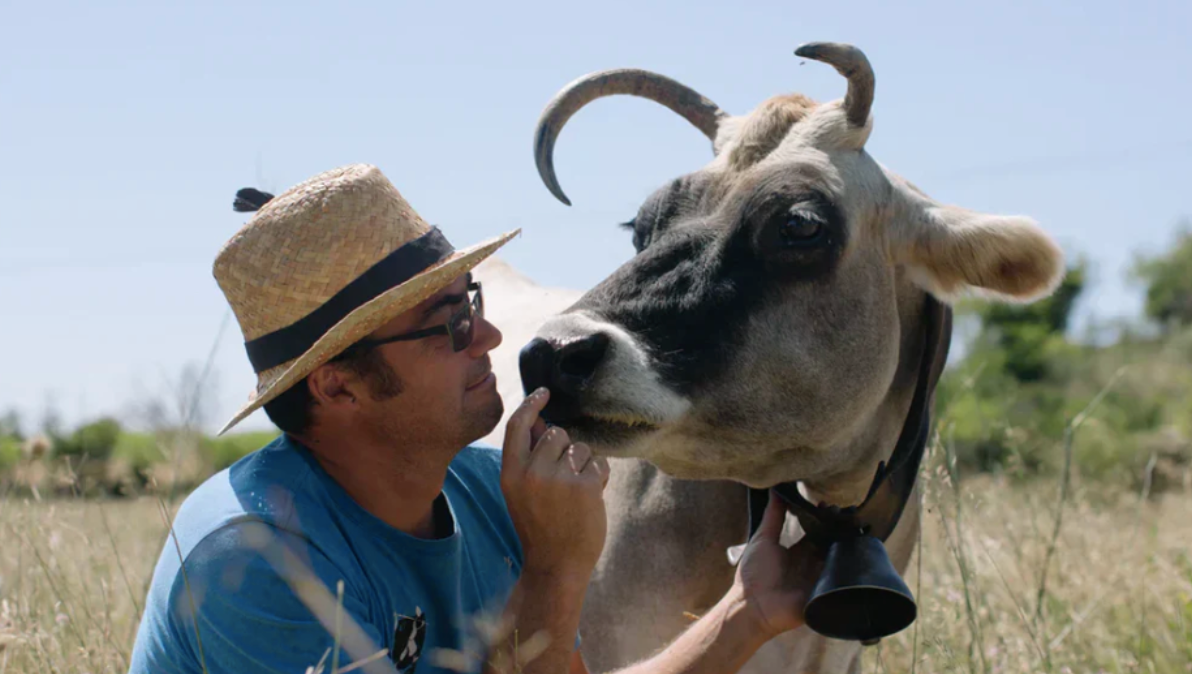
"When I arrived here, I understood immediately that this was a place for great wines: the wind, the drought, the stones. My job is to translate the place.”
– Olivier Pithon
Calce, a fairytale village within the Côtes Catalanes region of the Roussillon, is a winemaker's paradise of immense proportion. The village sits in the shadow of the looming Pyrenees, along the border of France and Spain, where the mountains meet the sea, rocky valleys of old, gnarled vines stretch for miles, and the landscape is dotted with vacant chateaux and remote, tiny villages. Many millennia of geological history have made this a jewel of varied terroir, producing striations of limestone and marl on one side and schist on the other.
Because of that patchwork of different soil types, the area around Calce has become a magnet for intrepid young wine-growers. Among them? Anjou-born, Bordeaux-trained Olivier Pithon, who settled just outside of the village itself, drawn to the great variety of terroir and community of winemakers committed to biodynamics and preservation of land.

Calce's identity is layered and complex, much like Pithon's own personal history, a myriad of ideas, insights, and experience that would eventually draw him there. He grew up among the vines in the Loire, where generations of his family carved out a name for themselves producing elegant, classic wines. At 18, he left Anjou to pursue his studies in Bordeaux and later took on internships across Beaujolais and Jurançon. He returned to Saint-Émilion for his first head winemaking role. While there, he connected with Stéphane Derenoncourt, a hugely influential winemaker and consultant widely credited with shaping the low-intervention, terroir-driven style of modern Bordeaux. Derenoncourt encouraged him to explore lesser-known regions to identify the terroir that most inspired him; in 2001, he discovered 7 old parcels in Calce, which captivated him instantly.
In Calce, Pithon found access to a mosaic of soil types and expositions, planted to varieties typical of this slice of Southern France: Grenache (Rouge, Gris, and Blanc), Carignane, Syrah, Mourvèdre, and Macabeu. The different soils that dominate the area are not separated by vineyard, or even parcel. Rather, the 3 major soil types (clay marl, limestone, and schist) sit in layers in the vineyard, imbuing into the vines the best characteristics from each: clay develops greater concentration, limestone improves vine vigor for racy acidity and firm tannin, and schist moderates the intense heat that bakes these vineyards in the summer. Taken together, this unique composition makes for structured, mineral-driven wines full of finesse and tension.

Olivier's approach in both the vineyard and cellar reflect the learnings he's collected over the years. He's a staunch believer in minimal intervention, putting full faith in the quality of his old vine material to produce wines of elegance, character, and balance (the core tenant of Derenoncourt's influence on winemaking in Bordeaux).
Pithon's entry-level, bistro-tuned P'tit bottlings are eminently drinkable and deceptively complex. The P'tit Rouge, a blend of equal parts Grenache, Syrah, and Mourvèdre is loaded with crunchy red fruits, spiced cranberry, and smoke-tinged orange peel, with an easy finish that lingers on the palate. The P'tit Blanc is a spirited blend of Grenache Gris, Grenache Blanc, and Macabeu, a mix of rounded orchard fruit matched by salt-kissed citrus and struck stone.
If the P'tit Pithon wines are direct evidence of the tremendous value the Côtes Catalanes offers, his D18 White, a blend of equal parts Grenache Gris and Grenache Blanc, showcases the immense quality the region is capable of producing. Sourced from 70+ year-old vines planted next to the namesake, single-lane road leading to the vineyard, it earned the rare “perfect wine” tag (underlined three times) in our initial tasting notes. A marvel of textural interest, aromatic complexity, and driving, mouthwatering acidity, the palate is brimming with stone fruit and a flourish of white floral aromatics leading to a lip-smacking, saline laden finish.
Pithon is among the best (and somehow, largely unheralded) winemakers in all of France. Get your hands on them now before the rest of the world catches on!