
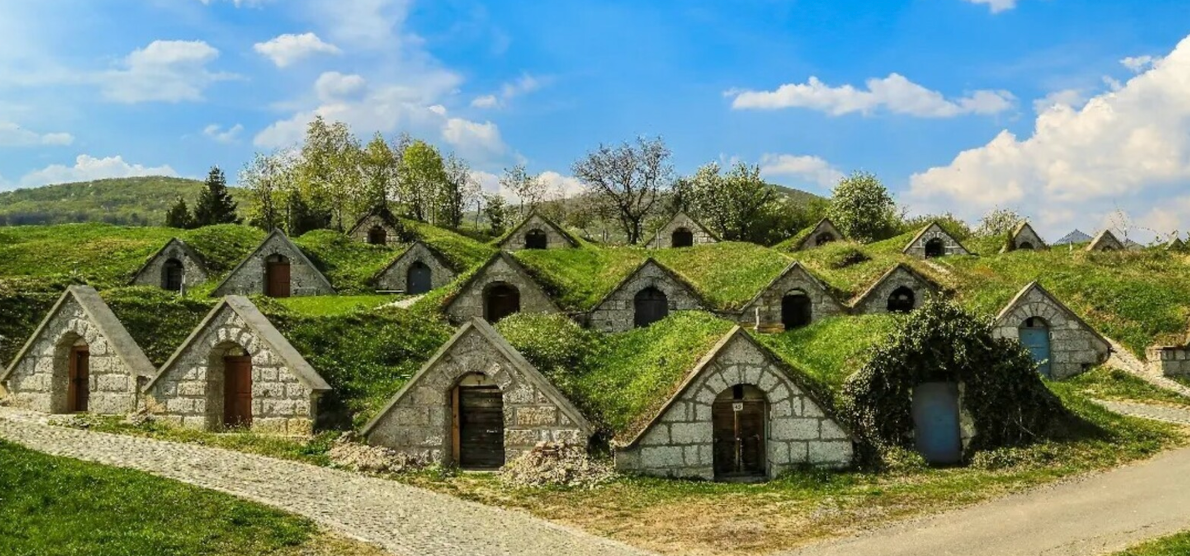
A first pass through Hajósi Pincefalu - a village of small family cellars dug into the hillsides with a connected winery and living space above - feels almost like an abandoned movie set rather than a living, breathing place. The rows of thatched-roof houses that sit above the linked cellar system and just below a stretch of vineyards, seemingly without property lines or borders, are largely empty. From the open doors of the few occupied properties, quiet, inquisitive eyes track the rare visitor's arrival past the abandoned, Soviet-era tractors that line the solitary road into town. It's an uncomfortable reminder of the great blow dealt to these villages by two world wars, and later by communist rule in Hungary.
It’s in this setting, at the end of a long path just before the nature preserve, buzzing with insects and energy, that Petra and Balázs Sziegl have set up shop in an unassuming row house, creaky, charming, and almost entirely unchanged by the passage of time.

The terraced vineyard that sits above the Sziegl house is a stage for a bucolic scene: a pop and fizz as Petra pours generously from an unmarked bottle of bubbles, one made with no commercial intention, just as a warm welcome for infrequent visitors; the shadows of scattered summer clouds passing over the village of Érsekhalma in the distance, threatening impending rain; the perfume from the late spring bloom, carried in waves with a gentle breeze; the hum of bees in the garden, observing with great interest the Mangalica salumi laid out on a shared table; this is, by any standard, pure, dizzying sensory overload. But this is not a typical experience in Hajós, at least not anymore.
Petra and Balázs took a real risk in setting up their winery here - there's no infrastructure, no schools, none of the resources that a young family needs. But the draw of these old vineyards, buffered by surrounding forests and once classified as 'grand cru' by the top families in the region, proved too alluring for Balázs, a viticulturist focused on clonal research and preservation of old vines, to resist. As a trained winemaker who had spent almost a decade in the cellar, Petra was enamored with the concentration of fruit and varietal character from these low-yielding vines. Despite the challenges of working in somewhat isolation in their new winery, she couldn't deny that the quality of the wines they were producing, even in their early vintages, was unlike what she had worked with previously.

Petra and Balázs' focus, as is so often the case in Hungary, was initially fixed primarily on Kadarka, the country's prized native variety. But Kékfrankos (Blaufrankisch to their Austrian neighbors) from the clay soils of the low-lying Hársfás-út vineyard vineyard was a revelation, its savory, herb scented dark fruit marked by tension and balance. This stretch of southern Hungary enjoys long, hot summers. Here, the generous shade from the nature preserve and cool mornings and nights allow these grapes to ripen slowly, building racy acidity without sacrificing ripeness.
The 2020 Hársfás-út Kékfrankos, much like a visit to the Sziegl property, makes every last sensory receptor stir. On the palate, the flavors seem to trace the timeline of an afternoon at the Sziegl property: a walk under the ripe cherry tree, the flowers singing in the sunshine, the air rich with paprika, juniper, and clove. It's a wine that doesn't just communicate a sense of place; rather, it transports the drinker to the place itself.
Darkly concentrated, generously spiced and savory, and with a finish as long as it is complex, it's somehow familiar and entirely singular in equal measure.
